
Fiberglass Engineering
FRP piping has been used in the oil and gas industry since the early sixties. The last decades have shown a large growth in the use of Fiber Reinforced Plastics (FRP). From the onset of the application of FRP systems, Triplet Engineers have been involved in the development and introduction of FRP in the industry. Triplet has unique service portfolio dedicated to the design of piping systems including Fiberglass systems. engineering services at all stages of the project life cycle, from initial feasibility studies and conceptual design during the FEED stage, followed by system design, materials specification and qualification up to engineering support during installation, hydrotesting, Pre-Commissioning and Commissioning.

For existing assets, we offer consultancy service for life extension with Pipeline Integrity Management support (PIMS) and Fit for Purpose (FFP) analysis. Typical customers are end users in the oil & gas domain, Petro chemical industry, energy domain but also pipe manufacturers and design and construction engineering companies.
The design, manufacturing, qualification and installation of FRP piping systems differs considerably from that of the more traditional materials and asks for dedicated design software and knowledge about the materials manufacturing and materials behavior.
We are actively involved in FRP Consultancy business starting from the concept, material selection and closely working with direct end users .This makes our services unique worldwide and has provided us a leading role as an engineering company specialized in FRP applications.
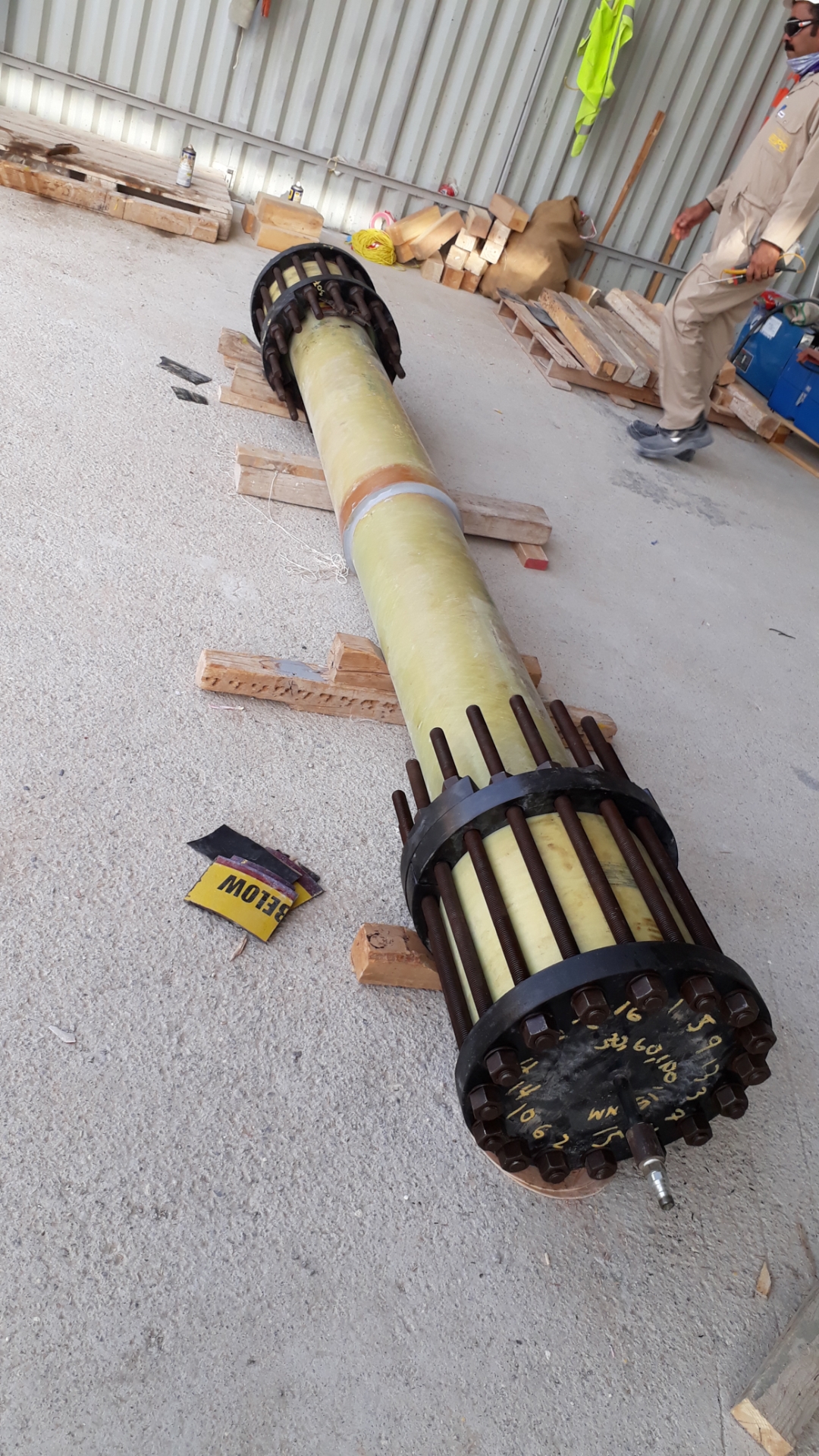
Fibre Glass Systems
Glass Reinforced Epoxy or GRE pipes are a valid alternative to carbon steel pipes, especially for corrosive, aggressive, and normal environments.
GRE pipe technology is based on the continuous Filament Winding process using high strength fiberglass (E-glass) and amine cured epoxy resin as basic material. Numerically controlled machines manufacture the product on a mandrel according to the cross-section filament winding process. The continuous glass fibers are helically wound at predetermined angles and bonded with the epoxy resin.
Lightweight and easy to handle and install GRE pipes have a smooth internal surface that reduces friction and enables a high pipe flow capacity. Low thermal conductivity of GRE pipes in comparison to steel (only one percent of steel values), minimizes the cost of insulation and heat loss. Another major benefit of GRE pipes is that once installed they are fundamentally maintenance-free. GRE pipes are well suited for environments where corrosion resistance at competitive prices is required.
GRE pipes offer a unique combination of high mechanical, thermal, and chemical resistance which is obtained by the selection of high-performance components and a proper design of the structure. The inner liner, which is made by a resin-rich layer reinforced with C-glass or synthetic veil, guarantees the pipe water tightness, its chemical and temperature resistance. The mechanical resistant layer is composed of successive layers of pre-stressed glass roving impregnated with epoxy resin and orientated with a precise, predetermined angle selected to achieve the properties required. The resin and the hardener system are selected with the consideration of the combination of properties required from the finished product. The glass reinforcement in the form of continuous roving is chosen based on its compatibility with epoxy resin. It is applied on the rotating mandrel following the hoop (radial) winding pattern combined with a helical winding pattern at an angle ranging from 45 to 90.
The amount, type, location, and orientation of glass fibers in the pipe will provide the required mechanical strength. The glass fibers most commonly used in the pipes are referred to as Types E, ECR, and C. Glass types ECR and C provide improved acid and chemical resistance. Type C glass fibers are generally only used to reinforce chemical-resistant liners.
Epoxy resins are used to a wide range of moderately strong acids and alkalis, conveying water, condensates, hydrocarbons, and caustics. Fiberglass epoxy piping is used in oil fields at pressures up to several thousand per square inch (kilopascals). Epoxy resins cannot be categorized by resin type as easily as polyesters. The type of curing agent or hardener is critical with epoxy resins because the agent influences the composite properties and performance for optimum chemical resistance, these mixtures usually require a heat cure and/or post-cure. The cured resin has good chemical resistance, particularly in alkaline environments, and can have good temperature resistance. There are several types of base epoxy resins and associated curing agents typically used for epoxy resin are cyclo aliphatic amine, aliphatic amine, Aromatic amine, Anhydride.
Modulus of Elasticity of FRP product will be 10?20 times less than the traditional metallic pipe. This is typical for all FRP products manufactured with E?glass. This is because of the strength of E?glass.
Capacity
Epoxies are relatively cheaper with superior properties that made them a choice for the fabrication of pipes. It is more viscous than any other thermoset plastic which has been an ideal choice for a filament winding process where impregnation of fiber can be done easily. GRE pipes are generally manufactured with an integral joint, which means that the socket (for bonding, lock, or thread) is produced simultaneously with the pipe body by winding on a specially designed metallic mold fixed at one end of the mandrel. The pipes are wound on precisely machined steel mandrels, the mandrel is extracted only when the pipe is cured. Curing can be done easily up to 180 C with two stages. It has typically low shrinkage on curing. It often provides better interactions with glass fibers. It has relatively high stiffness and strength, making it a better choice for fabricating pipes. Mechanical and physical properties of GRE product have been conducted as per ASTM and other related testing standards. The basic GRE pipe is constructed by a chemically resistant resin-rich barrier known as the liner as a base. The structural wall gives the pipe the strength to withstand internal pressure and external loads. the woven will be taken to cure at a specified temperature to provide better strength and durability. The capacity for GRE will be the ideal solution for the transmission of water, chemicals, effluent, and sewers. They combine the capacity of corrosion resistance and mechanical strength.


Glass tape or unidirectional reinforcements can be used to obtain local reinforcement. An external resin coating reinforced with a synthetic veil adds a finish to the pipe. Maximum Design Temperature shall be 110 degrees Celsius with the Tg value of fully cure resin stands at 130. GRE pipes and fittings can withstand 120 bar design pressure and above depend upon the jointing system.
It is commonly thought that the thermal Expansion of fiberglass is several times higher than carbon steel. But this is not true. Thermal expansion of fiberglass is at most 1.8 times that of Carbon Steel and at most 1.2 times that of Stainless Steel. And with some filaments wound FRP, the difference is much less. The value of the thermal expansion of FRP is highly dependent on the orientation of glass and the amount of glass in the product.
The thermal capacity of the FRP is 0.1?0.24 Btu?ft/hr?ft2?oF.
Even though FRP is plastic, but by using the certain fire retardant in FRP can perform very well in certain fire endurance condition. One characteristic that contributes to this is the melting point of materials. FRP product made with resin and glass. Resin cannot perform under high temperature of a fire, whereas melting point of glass is very high, and it can maintain much of its structural integrity during the fire. Because of those two combinations, Fire retardant FRP product can able to withstand up to 900 degree C for 30 min.
Mechanical and physical properties of GRE product has conducted as per ASTM and other related testing standard.

